28 November 2006

Purple Doorknobs


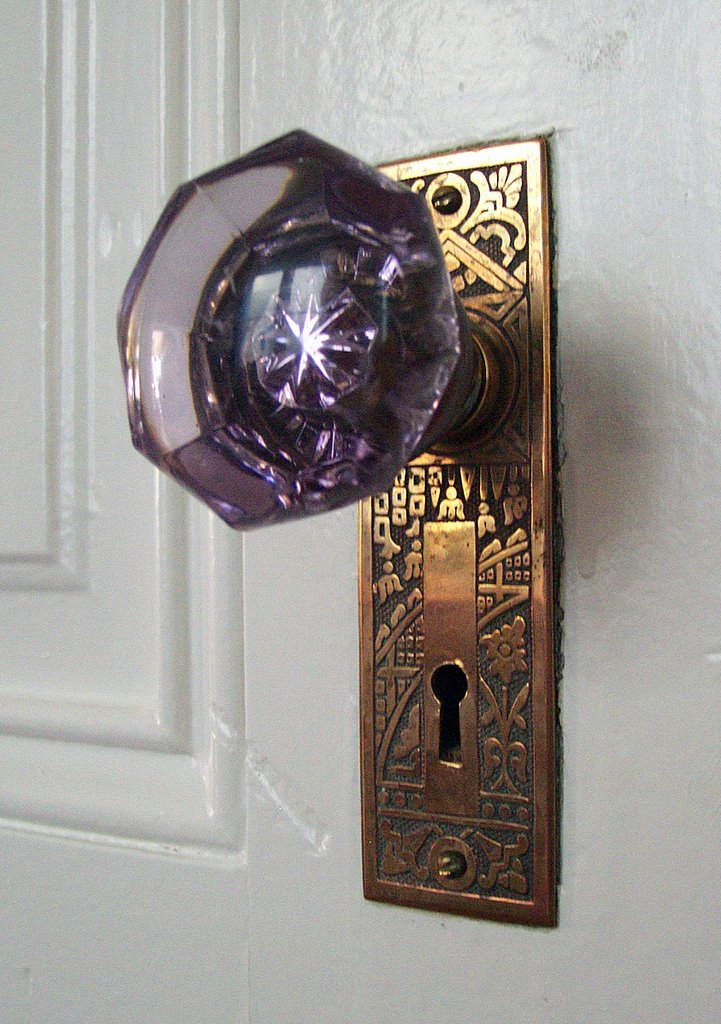
A few weeks ago I found a box of old doorknobs in the basement. Among them was a pair of purple glass doorknobs. "Those wacky Victorians," I thought, "making different colors of doorknobs just to dress the house up." I learned, however, that the doorknobs weren't supposed to be purple - they started out colorless. (Thanks to Dad and my friend Nicole the Museum Conservator for enlightening me.)

Glass is made from silicon dioxide (sand) heated to high temperatures. Most glass contains traces of iron, which gives the glass a greenish tint. An additive called a decolorizer offsets the greenish hue. Before 1915, manganese dioxide was a common decolorizer. It acts as an oxidizer for the iron, converting the iron into an iron oxide that produces a yellowish, much less intense tint. (I learned this from the ever-helpful Corning Glass company.) An unexpected result, however, is that manganese will turn pinkish or purplish if exposed to ultraviolet radiation like sunlight. My doorknobs are an example of this "purpling." Most glass that purples naturally was produced between 1880 and WWI. In Beacon Hill (Boston) there are old brownstones, famous for their fine architecture and purple windows which have deepened in hue over time.

This effect became popular among antiques collectors in the 1970's, and many dealers artificially purpled their glass by exposing it to sunlight or UV radiation, ruining the value of many pieces. Collectors of glass insulators are also cautioned that many shades of glass available for sale have been unnaturally tinted by similar processes.

Info about how glass is produced in different colors here

16 November 2006

More recycling on a large scale


I absolutely love old buildings. We live in a Victorian house built in 1889, and I often spend my weekends removing decades of paint layers to restore things like escutcheons and broken window locks. ("Escutcheon" is a word I learned from Babble over a year ago, and now I can use it in a sentence without cracking up!)

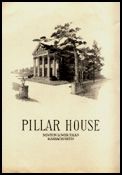
Given my love of historic architecture, you can imagine I was thrilled to learn that the Pillar House, a famous and fancy restaurant from my youth, has been given a new lease on life as a residence once again. The Pillar House was built in 1828 as a private residence on an empty spread of farmland, and was converted to a restaurant in 1952. The restaurant was known for its formality, its high standards (smoking and cell phone bans and a dress code), and its tradition of giving long-stem roses to female diners. (I remember getting one when I was about ten!) The restaurant closed in 2001, and the property, which had been hemmed in by freeways over the years, was seized by eminent domain.

This is the fun part of the story: the Pillar House was bought by a family who are reconstructing it as a residence on their farmland in Lincoln, Massachusetts. They're doing it right, too, consulting with the Newton Historical Society and spending effort on details like finding crown glass consistent with the era. When I visited my parents in October we drove by to take a peek, and the building looks just terrific tucked away in a peaceful setting much like its first spot in 1828.

Another example of this type of recycling is the famous London Bridge, which was built in 1831. In 1967, the bridge was determined to be structurally unsound, sinking into the Thames after so many years in the swift river current. It was purchased at auction in 1968 by an American, Robert McCulloch, who was developing the new town of Lake Havasu City, Arizona. The price paid was $2,460,000. The bridge was disassembled, with each stone numbered before it was shipped, and reassembled in Arizona over the next three years. It is now the second most popular tourist attraction in the state, after the Grand Canyon, and holds the title of Largest Antique Ever Sold in the Guinness Book of World Records.

For more great stories of building reuse, check out Conde Nast's list of hotels which used to be something else (article comes to me courtesy of C24).

08 November 2006

Reuse, Recycle, Recreate


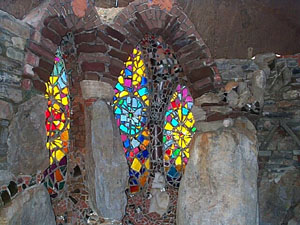
I grew up with a healthy appreciation for the possibilities of scrap - my dad's workshop in the basement always had the perfect piece of wood for a project, my mom's fabric bin had just the piece to inspire. I'm still at it, currently working to incorporate salvaged windows into my glass art, and making a clock out of miscellaneous cabinet and faucet knobs. I recently came across two funky residences, created out of salvaged building materials. Aside from that, they couldn't be more different!

Wing Castle, located in the Hudson River Valley, was built by Peter and Toni Ann Wing. In 1969 they started collecting building material from churches, a railroad bridge, and demolished sidewalks and buildings. "Finishing" their home took the greater part of three decades, though Peter Wing continues to work on new projects and appears to be developing a B&B part of the property. The castle incorporates odds and ends like a ship's bow, the bottom dome of a water tower, and an antique bird feeder. Awesome photos here and here and an article by Peter Wing himself here.

Anyone who's ever tried to get away from Logan Airport in the last twenty years has encountered the Big Dig, Boston's huge construction fiasco. Paul Pedini, an engineer on the project, salvaged 600,000 pounds of concrete and steel (used to construct temporary structures like freeways ramps and support posts for the Zakim Bridge) and built a 4300-square-foot, six-level house in Lexington, Massachusetts. Though the lot and the building costs came to about $1,000,000, Pedini got the materials for free and saved his company about $20,000 in disposal costs. The house features 27-foot ceilings, a rooftop Japanese garden, and (my favorite part) a cable-stayed bridge connecting two interior levels. Pedini is looking for other projects to incorporate used construction materials and support sustainable growth. Article (with photos) about his house here.

03 November 2006

Revisiting September 11th

I am slowly working my way through all the two-hour specials about 9/11 that I recorded a few months ago. I am carefully alternating them with TV shows that cheer me up, like Junk Brothers, and other healthy things like getting out of the house and eating leftover Halloween chocolate.

I started my work as a psychiatric social worker on September 12th, 2001. I spent my first shift on an urban mental health crisis team going around to fire stations, talking to firefighters who didn't want to talk to us, and handing out materials describing how to talk to your kids about the fact that you have a dangerous, possibly lethal job. It seemed trivial in the wake of what had happened, and my sense of helplessness was overwhelming. It took years to turn off social-worker mode and let the emotions of that day finally flow.

The Blue Man Group have created a powerful tribute video (though I am relieved to find that it is less powerful for me than it was three years ago - time does heal).

Exhibit 13 (better resolution, smaller screen)

Exhibit 13 (bigger screen, grainier)

And, in case you haven't saved up episodes of Junk Brothers to cheer you up:
here's something that might, filmed right here in San Francisco earlier this year.

26 October 2006

Quilting in Glass


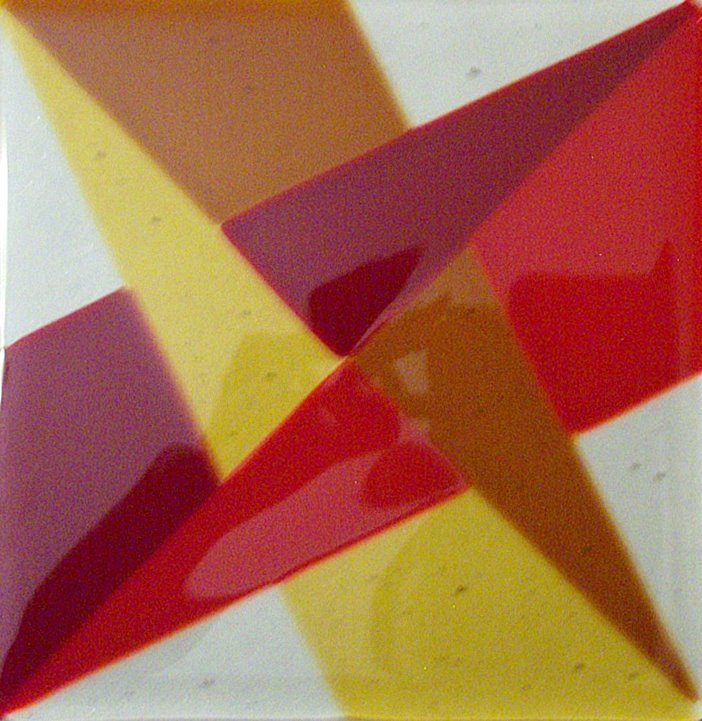
These are Glass Projects #4 and #5, the first pieces I made at home in my very own kiln. They are blocks of a traditional quilt pattern called "Crazy Amish Star". They are translucent but unfortunately I have not yet figured out how to photograph this kind of work successfully...

25 October 2006

59 Five-vowel words

Here is a list of words that have all five vowels in them, compiled in the last year by my students and the good people at Babble:

adventitiously
aeronautic
ambidexterously
arenicolous
auctioned
auctioneer
auditioned
augmentation
authoritative
autoerotic
behaviour
bougainvillea
cauterization
cautiousness
countermanding
dialogue
electrometallurgies
equivocal
eulogia
eunoia <--shortest with only 6 letters
euphoria
facetiously <-- has all vowels in alphabetical order
foundationless
gelatinous
gramineous
gregarious
hellacious
intravenous
miaoued
miscellaneous
mountaineer
nefarious
ostentatious
precarious
questionable
questionnaire
recapitulatory
regurgitation
reinstitutionalization
revolutionary
sacrilegiously
sequoia
subcontinental
ultraconservative
ultrafashionable
ultrarevolutionaries <-- has each vowel exactly twice
unaccompanied
unaccomplished
unappropriated
unauthorized
uncompanionable
uncongenial
uncontaminated
undemocratic
unexceptionably
unidirectional
unifoliate
unimpressionable
unincorporated

more geekiness like this

23 October 2006

Colonial Gravestones


Today J and I spent the day exploring Concord, Massachusetts with my parents. I was especially drawn to the old cemetery next to St. Bernard's church, where my grandmother and I used to go when we were early for Mass. Today the oldest grave we found marks a death in 1690. (Concord was settled in 1635.)

The artwork is beautiful, and I wished I had done a little research ahead of time to see if rubbings were allowed, and how to do gravestone rubbings without causing damage. Two helpful sources for advice of this nature are the Connecticut Gravestone Network and the Association for Gravestone Studies.

I learned new uses of words: a "consort" is a woman who predeceases her husband ("Sarah, consort of Josiah Wheeler") and a "relict" is a woman who is widowed by her husband. "Relict" can also refer to a child whose father has died.

There were some gravestones which were weathered to the point where they could not be read at all. I learned that sulfur dioxide and carbon dioxide from pollution (notably from burning coal) contribute to the weathering and destruction of headstones. Flat memorial stones are also damaged by sulfur dioxide and nitrogen oxides in acid rain.

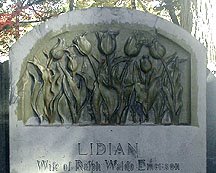
Our second stop was the Sleepy Hollow Cemetery, also in Concord, where my grandmother is buried. Sleep Hollow Cemetery is a tourist destination because of "Author's Ridge", where Nathaniel Hawthorne, Louisa May Alcott, Henry Thoreau, and Ralph Waldo Emerson are buried. (Today those four famous graves were marked with little pumpkins in honor of the season.)

The stories we pieced together were compelling - Revolutionary War Veterans, frequent remarrying due to untimely deaths, confusing intermarrying between families with familiar historical names, and tragedies such as the family who lost their three little girls, aged 5, 4, and 2, all within a week of each other.

I seem to be fascinated by things that people say I should find morbid.

17 October 2006

The Limerick Game

My friend C24 invented a fun game in which we write limericks by passing them back and forth between us, writing only one line at a time. We've come up with some terrible ones, which I won't share - but here are some of my favorites.

Written 19 January, 2006:

A man with a gimpy-legged shuffle
was killed by a poisonous truffle
"Alas, I am smote!”
were the last words he wrote
with a quill on the edge of his ruffle.


Written 22-29 January:
A painter who wore a beret
Heard a devious art dealer say,
"Just pretend that you're French
And dress like a wench;
I'll sell more of your paintings that way."


Written 14-15 March:
A boy with a shiny new bike
Had just traded in his old trike
"With two wheels, not three
I can ride fast and free
Since the front and the back are alike."


Written 18 June - 28 August:
I’ll never forget me first nanny
For she’d whack me quite hard on the fanny.
I wouldn’t have minded
Except that I’d finded
She caused pain in me least favorite cranny.


Written 17 October:
The boys at the long wooden table
Make fun of the horse in the stable.
Ah, if only they knew
What that horse likes to do
When he sneaks in the house to watch cable.


One we didn't write, in honor of the math geeks in my life:
A mathematician named Bath
Let x equal half that he hath.
He gave away y
Then sat down to pi
And choked. What a sad aftermath.


And finally, a wonderful example contributed by my Mom:
An erotic neurotic named Sid
Got his ego mixed up with his id.
His errant libido
Was like a torpedo
And that's why he done what he did!

09 October 2006

Lady Edisons


This weekend's TV theme at our house is Inventors and Inventions, and I've loads to tell about female inventors and their roles in our daily lives.

The US Patent Act of 1790 changed the rules and allowed women to hold patents if they were single or widowed. Since married women of the time were not allowed to own property in most states, and patents are intellectual property, most women could not hold patents despite the Patent Act. The first woman to hold a patent was Mary Dixon Kies, who lived in Connecticut, where law did not prevent married women from owning property independently. Her patent, issued 15 May 1809, was for a method of weaving straw and silk together to make hats. At the time, the United States had an embargo in effect on European goods (blame Napoleon) and the economy in the New England states, which had been heavily supported by imports, was suffering. Kies' method made it possible to produce hats quickly and efficiently, bolstering the local economy. (I looked for Kies' original patent document - it was apparently destroyed by a fire at the Patent Office in 1836.)

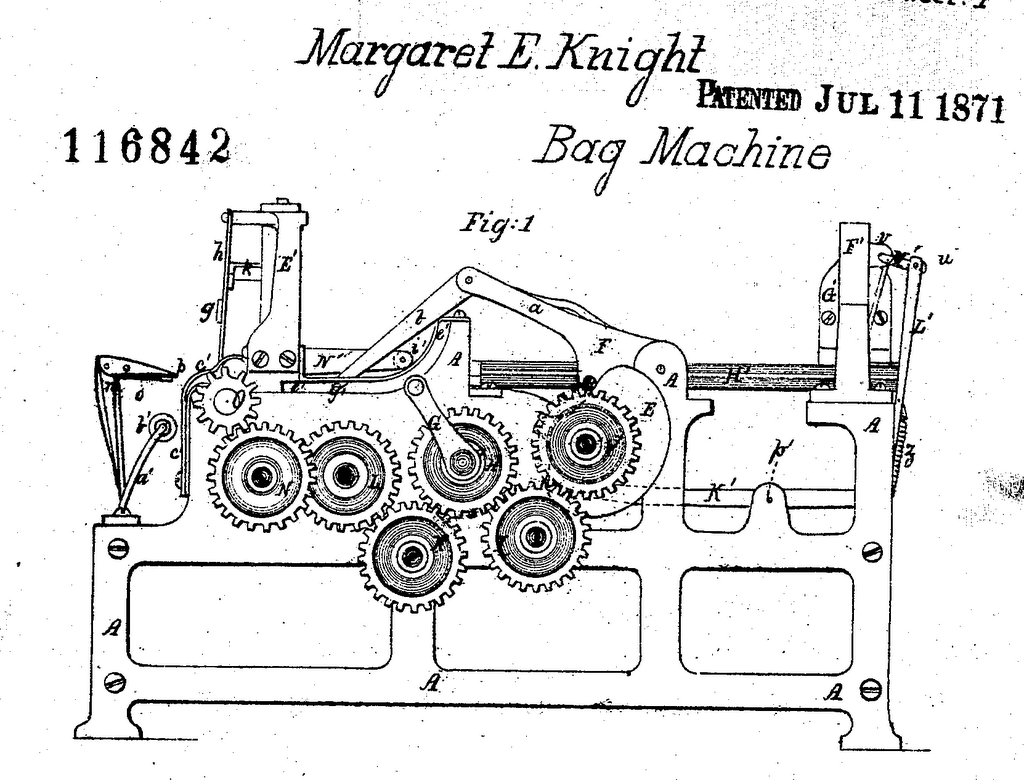
Margaret Knight absorbed her education of mechanics while working in paper and textile mills as a preteen and teenager. In 1868 she was working at a paper bag company in Massachusetts when she developed a machine that would automate the production of square-bottomed paper bags. (At the time, most paper bags had envelope-style bottoms; square-bottomed bags were handmade and prohibitively expensive for mass production.) She built a wood model of her machine and brought it to a machinist, since the patent office required an iron model. While the machinist was working on the job, a man saw Knight's machine and stole her patent. She brought a patent interference lawsuit against him, and won her patent in 1871. Her opponent's main defense in court was that a woman could not have possibly created such a mechanical invention. During this time, newspapers patronizingly referred to Knight as "Lady Edison". Over the course of her lifetime, Margaret Knight held many patents for machines relating mostly to textile and fashion industries.

Mary Engle Pennington was a chemist who specialized in bateriology. She researched safe handling of milk and dairy products, eventually convincing dairy farmers and street ice cream vendors to change some of their procedures to make their products safer. In 1905 she applied for a job with the USDA under the name "M. E. Pennington". Apparently the government did not realize she was female until after she received a promotion in 1906. Mary Engle Pennington designed refrigerated railroad cars, which allowed perishables to be shipped safely all over the country, and also improved the shipping of eggs with a new design for egg cartons.

One unlikely inventor is Hedy Markey, better known as Hedy Lamarr, who, together with pianist and composer George Antheil, developed a method of encoding radio signals called frequency hopping, an example of spread spectrum. Their method, which they patented in 1942, was based on the idea that radio transmissions could be hidden if they switched frequencies in a pattern that would be difficult for an eavesdropper to trace but easy to follow for someone with the appropriate key (in this case, a piano roll from a player piano). The government turned down the opportunity to buy a license for their method during WWII, but spread spectrum is used today in radio and cell phone technologies to make transmissions less prone to interference and eavesdropping.

And kevlar! Stephanie Kwolek first created kevlar fibers while working as a research chemist at DuPont in 1971. And Liquid Paper, which was invented by Betty Nesmith, a typist who enjoyed painting as a hobby, and mixed her own version of a white paint that would enable her to better correct mistakes. It goes on and on - windshield wipers, signal flares, no-wrinkle cotton - tons of stories about women inventing stuff. More good info here. I'm off to go tinker in the basement.
07 October 2006

Matrimonial Pearl of Wisdom and Poems

October is a month of many weddings for us, with three weekends in a row committed. Today's wedding gave us this pearl of wisdom, courtesy of Ogden Nash via cousin Molly:

To keep your marriage brimming
With love in the loving cup:
Whenever you're wrong, admit it;
Whenever you're right, shut up.

One of my favorite wedding poems is another Ogden Nash, Tin Wedding Whistle. My favoritest favorite, though, is The Owl and the Pussycat by Edward Lear.