21 December 2006

Ancora Imparo

Anyone who's gone out to dinner with me in the last few months has probably encountered my new favorite question: what are three things you learned today? Here is a random assortment of things I've learned in the last few weeks, in no particular order.

1) You do not know better than the cookie dough package how long the cookies should stay in the oven. Take the cookies out as instructed, even if they are still square on the top.

2) Teensy tiny pieces of glass, though small, still have teensy tiny razor-sharp edges capable of slicing your thumb open.

3) Many hardware stores do not carry black grout - call ahead.

4) When making a mirror mosaic, mask off the mirror early in the process so your worklight does not shine in your face and give you a headache.

5) "Thray" is not a word, though "echard" is.

6) It's eggnog season! Eggnog is good when mixed with chai.

7) US currency is printed on paper that is 75-80% recycled blue jeans (waste cotton) and 20-25% waste flax.

8) There is a sunken WWII sub in Norway containing 70 tons of mercury, as well as other heavy metals. Debates rage about whether to try to remove it or entomb it in sand and concrete. (Why not leave the sub there and pump the mercury to the surface? Anyone know?)

9) The seventh and final Harry Potter book will be called "Harry Potter and the Deathly Hallows".

10) When the freeway is flooded, walking under the overpass is extremely treacherous, as large amounts of cold sudden water tend to fall on you.

11) Except for water, we use more concrete (by volume) than any other substance in the world. Concrete made from volcanic ash will harden and cure underwater (thank you, Roman Empire).

12) Discount Builders Supply is perhaps the best hardware store in San Francisco (and it does have a big parking lot).

13) It is easy to find reasons to not mow the lawn.

What are three things you learned today?

Curvacious Glass


I've evolved in the past four months; I'm no longer feeling limited to projects that only use straight cuts!

14 December 2006

Math and Love


So glad I found this - I thought I was the only one who tried these analytic methods on everything.

I just took a three hour chemistry final. When my brain unfries, I will post some entries with a little more substance than I have of late. I am relishing a whole month of doing calculations without having to think about sigfigs!

07 December 2006

When Bunnies Go Bad


(With apologies to Ranger Bunny and Nicole.)

05 December 2006

More Cool Art


For those of you who are ready to move on after making a few snowflakes, behold the amazing art of Peter Calleson! His works, including incredibly detailed papercuts like this one, can be found at his website here.

28 November 2006

Purple Doorknobs


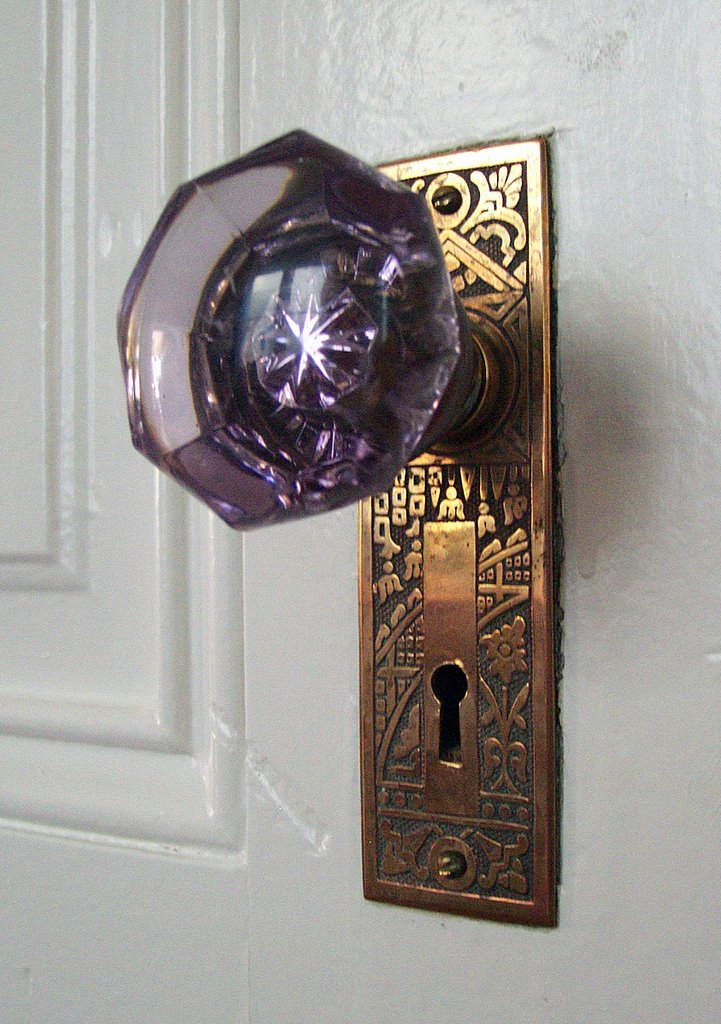
A few weeks ago I found a box of old doorknobs in the basement. Among them was a pair of purple glass doorknobs. "Those wacky Victorians," I thought, "making different colors of doorknobs just to dress the house up." I learned, however, that the doorknobs weren't supposed to be purple - they started out colorless. (Thanks to Dad and my friend Nicole the Museum Conservator for enlightening me.)

Glass is made from silicon dioxide (sand) heated to high temperatures. Most glass contains traces of iron, which gives the glass a greenish tint. An additive called a decolorizer offsets the greenish hue. Before 1915, manganese dioxide was a common decolorizer. It acts as an oxidizer for the iron, converting the iron into an iron oxide that produces a yellowish, much less intense tint. (I learned this from the ever-helpful Corning Glass company.) An unexpected result, however, is that manganese will turn pinkish or purplish if exposed to ultraviolet radiation like sunlight. My doorknobs are an example of this "purpling." Most glass that purples naturally was produced between 1880 and WWI. In Beacon Hill (Boston) there are old brownstones, famous for their fine architecture and purple windows which have deepened in hue over time.

This effect became popular among antiques collectors in the 1970's, and many dealers artificially purpled their glass by exposing it to sunlight or UV radiation, ruining the value of many pieces. Collectors of glass insulators are also cautioned that many shades of glass available for sale have been unnaturally tinted by similar processes.

Info about how glass is produced in different colors here

16 November 2006

More recycling on a large scale


I absolutely love old buildings. We live in a Victorian house built in 1889, and I often spend my weekends removing decades of paint layers to restore things like escutcheons and broken window locks. ("Escutcheon" is a word I learned from Babble over a year ago, and now I can use it in a sentence without cracking up!)

Given my love of historic architecture, you can imagine I was thrilled to learn that the Pillar House, a famous and fancy restaurant from my youth, has been given a new lease on life as a residence once again. The Pillar House was built in 1828 as a private residence on an empty spread of farmland, and was converted to a restaurant in 1952. The restaurant was known for its formality, its high standards (smoking and cell phone bans and a dress code), and its tradition of giving long-stem roses to female diners. (I remember getting one when I was about ten!) The restaurant closed in 2001, and the property, which had been hemmed in by freeways over the years, was seized by eminent domain.

This is the fun part of the story: the Pillar House was bought by a family who are reconstructing it as a residence on their farmland in Lincoln, Massachusetts. They're doing it right, too, consulting with the Newton Historical Society and spending effort on details like finding crown glass consistent with the era. When I visited my parents in October we drove by to take a peek, and the building looks just terrific tucked away in a peaceful setting much like its first spot in 1828.

Another example of this type of recycling is the famous London Bridge, which was built in 1831. In 1967, the bridge was determined to be structurally unsound, sinking into the Thames after so many years in the swift river current. It was purchased at auction in 1968 by an American, Robert McCulloch, who was developing the new town of Lake Havasu City, Arizona. The price paid was $2,460,000. The bridge was disassembled, with each stone numbered before it was shipped, and reassembled in Arizona over the next three years. It is now the second most popular tourist attraction in the state, after the Grand Canyon, and holds the title of Largest Antique Ever Sold in the Guinness Book of World Records.

For more great stories of building reuse, check out Conde Nast's list of hotels which used to be something else (article comes to me courtesy of C24).

08 November 2006

Reuse, Recycle, Recreate


I grew up with a healthy appreciation for the possibilities of scrap - my dad's workshop in the basement always had the perfect piece of wood for a project, my mom's fabric bin had just the piece to inspire. I'm still at it, currently working to incorporate salvaged windows into my glass art, and making a clock out of miscellaneous cabinet and faucet knobs. I recently came across two funky residences, created out of salvaged building materials. Aside from that, they couldn't be more different!

Wing Castle, located in the Hudson River Valley, was built by Peter and Toni Ann Wing. In 1969 they started collecting building material from churches, a railroad bridge, and demolished sidewalks and buildings. "Finishing" their home took the greater part of three decades, though Peter Wing continues to work on new projects and appears to be developing a B&B part of the property. The castle incorporates odds and ends like a ship's bow, the bottom dome of a water tower, and an antique bird feeder. Awesome photos here and here and an article by Peter Wing himself here.

Anyone who's ever tried to get away from Logan Airport in the last twenty years has encountered the Big Dig, Boston's huge construction fiasco. Paul Pedini, an engineer on the project, salvaged 600,000 pounds of concrete and steel (used to construct temporary structures like freeways ramps and support posts for the Zakim Bridge) and built a 4300-square-foot, six-level house in Lexington, Massachusetts. Though the lot and the building costs came to about $1,000,000, Pedini got the materials for free and saved his company about $20,000 in disposal costs. The house features 27-foot ceilings, a rooftop Japanese garden, and (my favorite part) a cable-stayed bridge connecting two interior levels. Pedini is looking for other projects to incorporate used construction materials and support sustainable growth. Article (with photos) about his house here.

03 November 2006

Revisiting September 11th

I am slowly working my way through all the two-hour specials about 9/11 that I recorded a few months ago. I am carefully alternating them with TV shows that cheer me up, like Junk Brothers, and other healthy things like getting out of the house and eating leftover Halloween chocolate.

I started my work as a psychiatric social worker on September 12th, 2001. I spent my first shift on an urban mental health crisis team going around to fire stations, talking to firefighters who didn't want to talk to us, and handing out materials describing how to talk to your kids about the fact that you have a dangerous, possibly lethal job. It seemed trivial in the wake of what had happened, and my sense of helplessness was overwhelming. It took years to turn off social-worker mode and let the emotions of that day finally flow.

The Blue Man Group have created a powerful tribute video (though I am relieved to find that it is less powerful for me than it was three years ago - time does heal).

Exhibit 13 (better resolution, smaller screen)

Exhibit 13 (bigger screen, grainier)

And, in case you haven't saved up episodes of Junk Brothers to cheer you up:
here's something that might, filmed right here in San Francisco earlier this year.